![]()
Customized assembly combining a single-gang rotary potentiometer with a pre-soldered 3-core lead wire harness, designed specifically for electronic devices requiring analog adjustment functions such as volume control, brightness adjustment, speed control, or temperature setting. It is widely used in audio amplifier equipment, lighting dimmer controllers, fan speed controllers, small appliance control panels, musical instrument effects units, and various electronic products requiring knob-style analog signal adjustment. The rotary potentiometer is a mature and long-established electronic component that changes the position of a sliding contact on an internal resistive element through rotational movement of the shaft, enabling continuously adjustable output resistance or voltage division ratio. It remains a classic solution for achieving smooth, continuous adjustment in analog circuit design, and compared with digital encoders, rotary potentiometers still offer distinct advantages in terms of adjustment feel, cost control, and circuit design simplicity.
This product has the lead wires pre-soldered directly onto the potentiometer's three standard terminal posts at the factory (typically corresponding to the two fixed ends of the resistive element and the center tap of the sliding contact), eliminating the need for customers to perform additional manual soldering during their own production assembly process. This pre-soldering design significantly improves the customer's production line assembly efficiency, reduces quality risks such as cold joints, solder bridging, or insufficient joint strength that can arise from manual soldering, and ensures that the soldering quality of every unit meets a consistent, controlled standard before shipment. The soldering process uses high-quality lead-free solder, producing full, smooth solder joints with strong adhesion that can withstand a certain degree of pulling and vibration without desoldering or wire breakage — fully ensuring connection reliability under real-world usage conditions.
The potentiometer body is constructed with a high-quality metal or engineering plastic housing, and the internal resistive element material can be selected as carbon film, conductive plastic, or wire-wound type according to actual customer requirements, meeting applications with different precision, lifespan, and power needs. The rotating shaft offers smooth rotation with a moderate damping feel, resisting looseness or sticking even after repeated long-term rotation. The 3-core lead wire is manufactured from high-quality copper core conductors, wrapped in a wear-resistant, aging-resistant insulation sheath, with the wire ends left bare or crimped with corresponding terminals (such as XH or Dupont connectors) according to customer requirements. We support in-depth customization of the potentiometer's resistance value (such as common values of 10KΩ, 50KΩ, or 100KΩ), whether a switch function is included, the rotational angle range, the length and color assignment of the lead wires, and the terminal type at the wire end, according to actual customer product design requirements. During production, we strictly implement solder joint quality inspection, resistance accuracy testing, and rotational life-cycle testing as part of a multi-layered quality control process, ensuring every unit meets relevant industry standards before shipment — providing customers with a stable, reliable, plug-and-play customized potentiometer lead wire assembly solution.

 English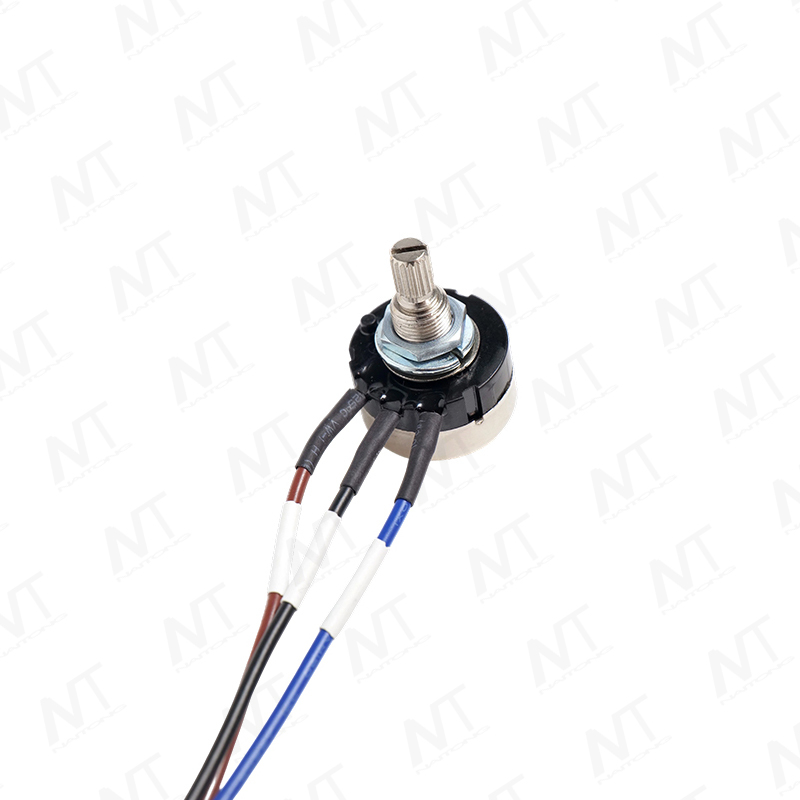

 Cooperate with us