 English
 Deutsch
 Español
 Tiếng Việt
 русский
 عربى

Wire Harness: Applications, Selection Criteria, and Practical Guidance
Content
A wire harness is the part of a product that nobody notices until something goes wrong. It is the organized bundle of conductors, connectors, sleeving, and ties that carries power and signals between the components of a machine, and the difference between a harness that survives a decade of vibration and one that fails in the field usually comes down to a handful of quiet decisions made early in the design.
We have spent years building harnesses for vehicles, medical equipment, factory machinery, and connected homes, and the questions we hear from engineers are remarkably similar across all of those industries. This guide collects what we have learned in one place.
What a Wire Harness Actually Does
Strip away the marketing language and a wire harness is a packaging and organizing solution. Instead of running individual wires one at a time through a chassis, you build a single assembly that already knows its shape: the right lengths, the right branches, the right connectors crimped on the ends, and the right protection wrapped around anything that might rub, flex, or get hot.
That single decision pays off in several ways at once. Installation becomes a repeatable step rather than a skilled craft, because the assembler plugs in one part instead of routing dozens of loose leads. Wiring mistakes drop sharply. Service technicians can trace a fault to a labeled branch instead of a tangle. And the bundle itself protects the conductors from abrasion, moisture, and electromagnetic noise that would otherwise shorten the life of the product.
It helps to separate two terms that get used loosely. A cable assembly is usually a single cable terminated with connectors at both ends. A wire harness is generally larger and more complex, with multiple conductors, breakouts, and several terminations. In practice the boundary blurs, and many projects sit somewhere between the two.
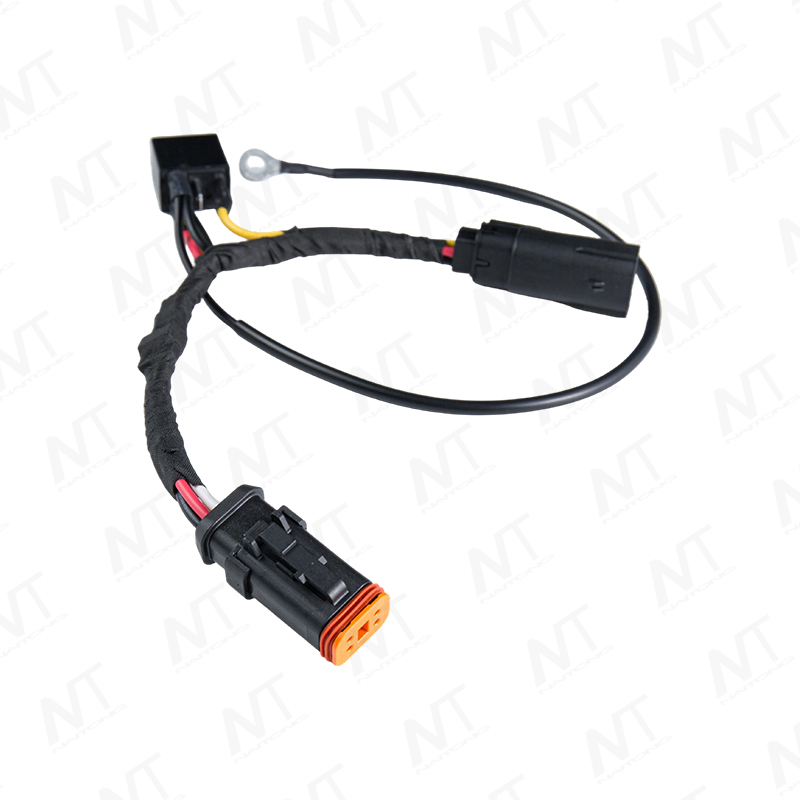
The Anatomy of a Wire Harness
Every harness is assembled from the same few families of parts. The choices within each family are what determine cost, durability, and manufacturability.
| Element | Job it performs | Typical options |
|---|---|---|
| Conductors | Carry power or signal | Stranded copper, tinned copper, various gauges |
| Insulation | Isolates conductors and resists heat or abrasion | PVC, XLPE, silicone, PTFE |
| Connectors and terminals | Join the harness to the device | Crimp or solder, sealed or unsealed housings |
| Protective sleeving | Groups wires and shields against wear | Braided sleeve, corrugated tubing, tape wrap |
| Branching hardware | Holds the routing shape in place | Breakouts, clips, heat-shrink boots |
None of these parts is exotic on its own. The engineering work lies in combining them so that the finished assembly still fits the space it was designed for, still passes its electrical tests, and can still be built at volume without the cost creeping away.
Design Decisions That Shape Reliability
Start with the environment, not the schematic
Before choosing a single part, we ask where the harness will live. A cable that bends thousands of times per day needs fine-strand conductors and a jacket rated for flexing. A harness routed near an engine or a heater needs insulation that keeps its properties at temperature. A medical harness that gets cleaned repeatedly needs materials that tolerate the cleaning agents without cracking. Answering these questions first prevents the expensive habit of redesigning after tooling has been cut.
Routing, bend radius, and strain relief
Most field failures we are asked to diagnose begin at the connector, not in the middle of the wire. A conductor that takes the full load of a pulling force will eventually break at the crimp. Give the harness a proper bend radius, anchor it close to the connector, and let the strain relief take the mechanical stress so the termination does not have to.
Shielding and separation
Signals and power do not always coexist politely. Where a low-level sensor line shares a bundle with switching power, shielding, twisted pairs, or simple physical separation can decide whether the product is stable or noisy. This is the point where a two-minute conversation between the electrical and mechanical teams saves weeks of troubleshooting later.
Documentation that production can follow
A harness drawing is not finished until someone on the line can build from it without guessing. That means a clear bill of materials, wire colors and gauges, cut lengths, strip lengths, crimp heights, a routing diagram, and a test specification. Good documentation is also the foundation of consistent quality across production runs and across factory sites.
From Drawing to Finished Assembly
The manufacturing sequence is fairly consistent regardless of application, though the details shift with volume and complexity.
- Review the drawing and confirm materials, tolerances, and test requirements with the customer.
- Build a prototype or first article so fit and function can be checked in the real assembly.
- Cut and strip conductors to length, then crimp or solder terminals to specification.
- Lay out the bundle on a board that mirrors the final routing, then add sleeving, tape, and ties.
- Run electrical and mechanical tests, including continuity, pull strength, and dimensional checks.
- Package, label, and ship in a way that keeps the harness in shape until it reaches the line.
The first article stage is where most surprises surface, which is exactly why we prefer to reach it early rather than after a full production commitment.
Where Wire Harnesses Are Used
The same design principles show up across industries, but each one leans on different priorities.
- Automotive and electric vehicles, where vibration, temperature swings, and long service life dominate the specification.
- Medical devices, where cleanliness, reliability, and documentation carry equal weight.
- Industrial automation and control cabinets, where noise immunity and ease of maintenance matter most.
- Smart home systems and control electronics, where compact routing and clean appearance drive the layout.
- Motor drives, chargers, and power supplies, where current capacity and thermal margins set the conductor size.
- Computers, audio equipment, and signal or data links, where impedance and shielding decide performance.
Our own product families follow that same map: automotive and EV harnesses, industrial control cables, medical harnesses, smart home wiring, signal and data cables, electronic wire harnesses, and AC power cords, alongside the wires and cables that feed them.
What Gets Checked Before a Harness Ships
Inspection is not a single gate at the end of the line. It is a series of small confirmations that catch problems while they are still cheap to fix.
- Incoming material verification for wire gauge, insulation type, and connector part numbers.
- In-process checks on strip length, crimp height, and terminal seating.
- Continuity and point-to-point mapping against the drawing.
- Dielectric and insulation resistance testing where the application requires it.
- Pull testing on terminations and visual inspection of sleeving, labeling, and branch geometry.
- Final dimensional verification against the routing diagram.
Customers often ask us to go further and build the inspection plan around their own acceptance criteria, which is a conversation worth having before the first order rather than after.
Choosing a Wire Harness Partner
The right partner is the one whose habits match the way you work. If your volumes are modest and your design is still moving, you need a supplier who can prototype quickly and absorb changes without drama. If you are transferring a mature product into volume production, you need stable processes, documented specifications, and a factory that can hold tolerances across thousands of units.
We are an electronics manufacturer based in the Jiaxing National High-tech Zone, roughly fifty minutes from Shanghai Hongqiao Airport and about an hour from Hangzhou and Suzhou. The company began in 2013 with work on new energy vehicle controllers, sensors, and wiring, and grew into a high-tech enterprise that designs and builds electronic harnesses, automotive harnesses, and related cable assemblies. Our site covers around 10,000 square meters, with thirty production lines organized by product type and a team of more than 300 people. Alongside automated harness equipment and injection molding capability, we keep a range of test instruments in house so that verification does not have to wait on an outside lab. Our work is supported by engineering and manufacturing staff who have seen enough projects to know which questions to ask early.
We also operate through both a Chinese factory and a Vietnamese factory, which gives customers options when regional sourcing or delivery planning enters the picture. Much of our business is built on OEM and ODM collaboration, where we take a customer's requirement and carry it through design support, sample validation, and series production. If you would like to see how that process would work for your product, our team is happy to walk through it with you and review the factory and certification information that matters to your evaluation.
A wire harness rarely gets credit for a product working well, but it is very good at explaining why a product failed. Treat the harness as a designed system rather than an afterthought, document it properly, and test it before it leaves the building, and it will quietly do its job for years.
If you are at the stage where a drawing exists but the manufacturing path is still unclear, send it over. Looking at a harness early is always cheaper than fixing one late.
Recommended Products
Contact Us
 Cooperate with us

Contact Us
-

Telephone:
+86-0573–82791220
+86-0573-83981882
-

Mobile phone:
+86-13736458379
+86-17506661888
-

Email:
shawn.p@jxnaitong.com
ft01@jxnaitong.com
george.cao@jxnaitong.com
-

Address:
No. 2889 Zhongshan West Road, Jiaxing City, Zhejiang Province, China
Factory C7.05, Plot C-7-CN, N17 Road, Bao Bang Industrial Zone Expansion, Bao Bang Village, Ho Chi Minh City, Vietnam.
Copyright © JIAXING NT ELECTRONIC TECHNOLOGY CO., LTD. Custom Wire Harness Solutions Cable Harness Manufacturers OEM/ODM Wire Harness Factory
