 English
 Deutsch
 Español
 Tiếng Việt
 русский
 عربى

Electronic Wire Harness Guide: Design, Types, and Custom Manufacturing
Content
- 1 What an electronic wire harness really does
- 2 Start with the working parts, not the drawing title
- 3 Common electronic wire harness patterns
- 4 Matching the harness to the application
- 5 Design details that prevent late surprises
- 6 From sample to production without guesswork
- 7 A practical partner for custom work
- 8 Questions worth asking before approval
An electronic wire harness is one of those parts that rarely gets attention until something goes wrong. It sits behind a panel, under a dashboard, inside a medical cart, or along a smart-home controller, quietly carrying power and signals. When it fits well, assembly is faster, routing is cleaner, and field failures drop. When it does not, the problem can look like a connector issue, a firmware fault, or a loose terminal. At Naitong, we build harnesses for many of these situations, and we have learned that the best result usually comes from a practical conversation rather than a rushed drawing.
What an electronic wire harness really does
A harness is more than a bundle of wires. It is a controlled assembly that combines conductors, insulation, terminals, connectors, sleeving, labels, and sometimes splices or overmolded parts. Each element has a job: carry current safely, hold a signal cleanly, protect against vibration or moisture, and make assembly predictable.
That is why a useful harness drawing needs to show more than wire colors. It should define the electrical path, the termination method, the routing shape, the bend allowance, and the inspection points. A harness that looks simple on paper can still create problems if the wire gauge is too light for the load, the terminal does not match the housing, or the bundle is too stiff for the space it must occupy.
Start with the working parts, not the drawing title
Before choosing a connector or setting a length, we usually walk through a few basics. These questions are not formalities; they shape the harness and the manufacturing method.
- Electrical load: Continuous current, peak current, voltage drop, and signal sensitivity all affect wire size and shielding.
- Environment: Heat, oil, water, flexing, vibration, and cleaning chemicals narrow the choice of insulation, sleeving, and sealing.
- Termination: Crimp, solder, insulation displacement, or board-level connection must suit the terminal, the wire, and the expected vibration.
- Assembly flow: The harness should be easy to route, keyed to prevent wrong mating, and simple to inspect on the line.
- Service: If a connector must be reached during maintenance, the harness needs enough slack and clear labeling.
These decisions are easier when the mechanical envelope, connector sample, and target cost are brought into the discussion early. Small changes at that stage often avoid expensive changes later.
Common electronic wire harness patterns
There is no single shape for a harness. The layout follows the device. A compact control board may need a short point-to-point cable, while a larger machine may need a branched assembly that reaches several sensors and switches. The table below compares the patterns we see most often.
| Harness pattern | Typical use | Design focus |
|---|---|---|
| Point-to-point | Board-to-board, switch, sensor, or module link | Clean length, strain relief, keyed mating |
| Branched assembly | Several loads or sensors from one source | Branch labels, bundle breakouts, service access |
| Ribbon or flat cable | Compact signal runs inside enclosures | Pitch alignment, fold radius, connector spacing |
| Shielded bundle | Noise-sensitive data or audio paths | Grounding method, shield coverage, drain wire |
| High-current link | Battery, motor, power inlet, or charger wiring | Gauge, temperature rise, terminal contact, fusing |
Ribbon and flat-cable designs deserve a special mention in compact electronics. They save space, but they are less forgiving of sharp folds and uneven connector placement. A small change in the fold direction can affect both fit and signal quality.
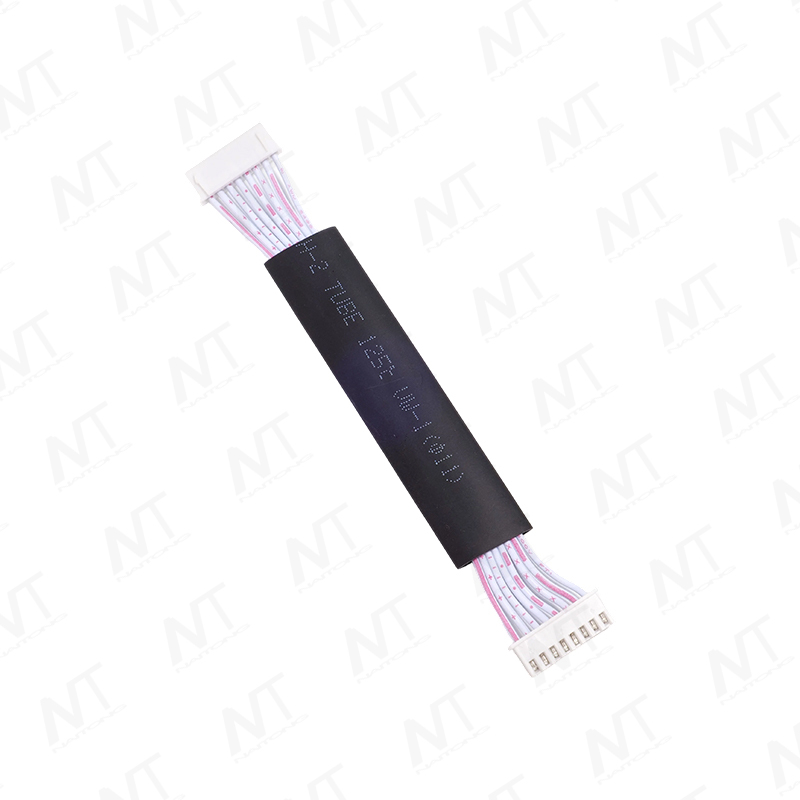 Custom Ribbon Cable Wire Harness for Compact ElectronicsFlat, space-saving harness with fixed conductor positions and connector options, suited to tidy multi-signal routing in compact electronic assemblies.View Product →
Matching the harness to the application
The same basic harness idea behaves differently across product categories. Automotive and EV assemblies may see vibration, temperature swings, and sealed connections. Medical devices often need clean routing, dependable mating, and materials that suit repeated handling. Industrial cabinets demand clear separation of power and signal paths. Smart-home products need compact branching and consistent connector orientation.
Automotive and EV connections
In vehicle and electric-drive work, power and signal often share the same envelope. High-current paths need correct conductor size and terminal contact, while sensor and control lines need protection from noise and movement. Routing clips, sleeve choices, and strain relief matter as much as the connector itself. A harness that passes a bench test can still fail in service if the bundle is allowed to rub against a bracket or pull on a terminal.
Medical and industrial equipment
Medical harnesses often combine delicate signal leads with power and control wiring. ECG lead sets, wheelchair power and control harnesses, and equipment-internal assemblies each bring their own handling concerns. In industrial settings, servo power, encoder signals, digital input and output wiring, and waterproof connections often call for separated paths and clear labeling.
Smart home, signal, and data
Consumer and building products tend to be compact, so harnesses must follow tight mechanical shapes without creating stress at the connector. Power distribution, LED and sensor wiring, USB and audio links, and Ethernet or serial connections all benefit from consistent lengths and keyed housings. When several small loads share one source, a branched design can simplify assembly and reduce loose wiring.
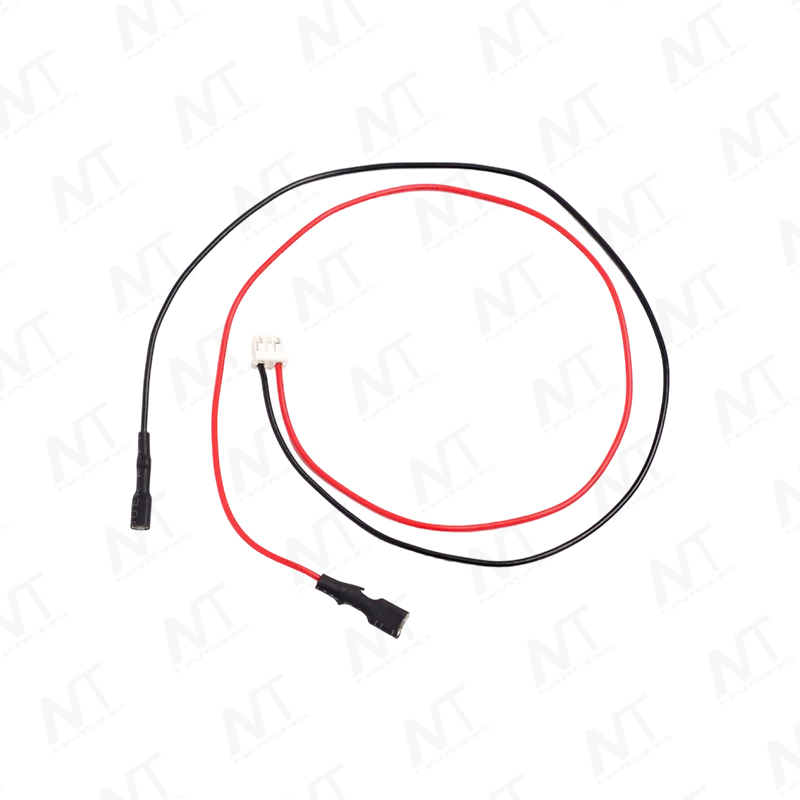 XH 3-Pin to Spade Terminal Adapter HarnessConverts XH board connections to spade terminals for quick power or signal links in compact consumer, LED, and appliance wiring.View Product →
For compact signal and DC distribution inside smart-home devices, the harness often has to split one input into several outputs while keeping each branch identifiable. That is where connector choice and branch labeling save time on the assembly line.
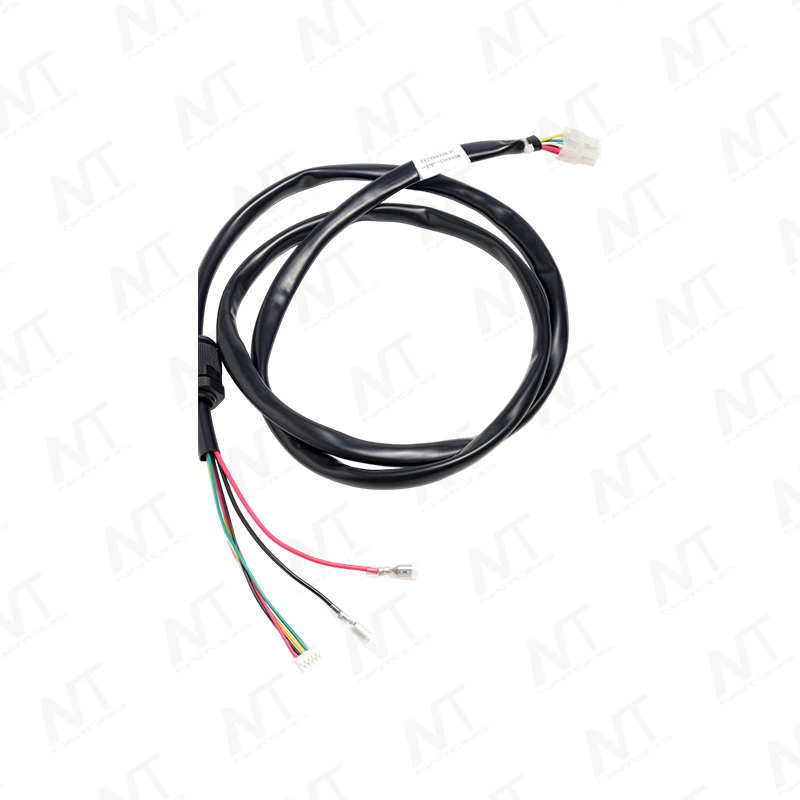 MOLEX 5557 6-Pin to XH or Spade HarnessCustom adapter harness with secure MOLEX 5557 latching and XH or spade output, useful for mixed-interface power and signal wiring.View Product →
Design details that prevent late surprises
Most harness problems are visible long before production if the drawing is reviewed carefully. We look for a few common risks:
- Wire gauge that meets the load with margin for temperature rise.
- Terminal and housing combinations that are actually compatible.
- Bend radius that fits the installed space, not only the flat drawing.
- Strain relief at connectors that may be pulled during assembly or service.
- Shielding and grounding that are defined, not left to the builder.
- Labels and test points that let inspectors confirm the build.
It also helps to agree on the test method early. Continuity, polarity, hi-pot, pull test, or dimensional check may all be appropriate, but the list should match the risk. A clear first-article review catches small errors before they reach a production line.
From sample to production without guesswork
A smooth custom build usually follows a simple path. First, the requirement is translated into a drawing or a sample brief. Next, materials and connectors are checked against availability and process fit. A prototype or pilot lot then confirms the routing, crimp quality, and assembly feel. Once the design is stable, the build is documented and the inspection points are fixed.
That sequence matters because electronic wire harnesses are easy to copy but harder to reproduce well. Length tolerances, terminal height, seal placement, and label position can drift if they are not written down. If you want a deeper walk-through of design and customization, our electronic wire harness guide covers additional detail. For projects that need a tailored build, our OEM and ODM support can follow the same review path from sample to repeat production.
A practical partner for custom work
Naitong has been working in wiring and cable assemblies since 2013. Our product range includes AC power cords, automotive and EV harnesses, electronic wire harnesses, industrial control cables, medical harnesses, signal data cables, smart home harnesses, and wire and cable. Our Jiaxing site covers around 10,000 square meters, with 30 production lines, more than 300 employees, testing instruments, automated harness equipment, and injection molding equipment. That breadth helps us look at the whole connection, not just one connector.
We prefer to ask practical questions early: What is the harness doing? Where does it bend? Who will install it? What must the inspector see? Those answers usually lead to a cleaner design and a more stable build.
Questions worth asking before approval
Before a harness drawing is released, it is worth checking a short list. Does every branch have a clear destination? Are the lengths measured from the correct reference point? Are the terminals, seals, and housings specified as a complete set? Is the label placement visible after installation? Has the harness been routed through the actual device, not only on a screen? These questions are simple, but they catch many of the issues that otherwise appear during the first build.
A good electronic wire harness is quiet in the best sense. It fits, it connects, and it stays reliable without drawing attention. Getting there takes a clear drawing, a realistic review, and a manufacturing partner who is willing to ask why before simply quoting a price. If that approach fits your next project, we would be glad to review the details with you.
Recommended Products
Contact Us
 Cooperate with us

Contact Us
-

Telephone:
+86-0573–82791220
+86-0573-83981882
-

Mobile phone:
+86-13736458379
+86-17506661888
-

Email:
shawn.p@jxnaitong.com
ft01@jxnaitong.com
george.cao@jxnaitong.com
-

Address:
No. 2889 Zhongshan West Road, Jiaxing City, Zhejiang Province, China
Factory C7.05, Plot C-7-CN, N17 Road, Bao Bang Industrial Zone Expansion, Bao Bang Village, Ho Chi Minh City, Vietnam.
Copyright © JIAXING NT ELECTRONIC TECHNOLOGY CO., LTD. Custom Wire Harness Solutions Cable Harness Manufacturers OEM/ODM Wire Harness Factory
